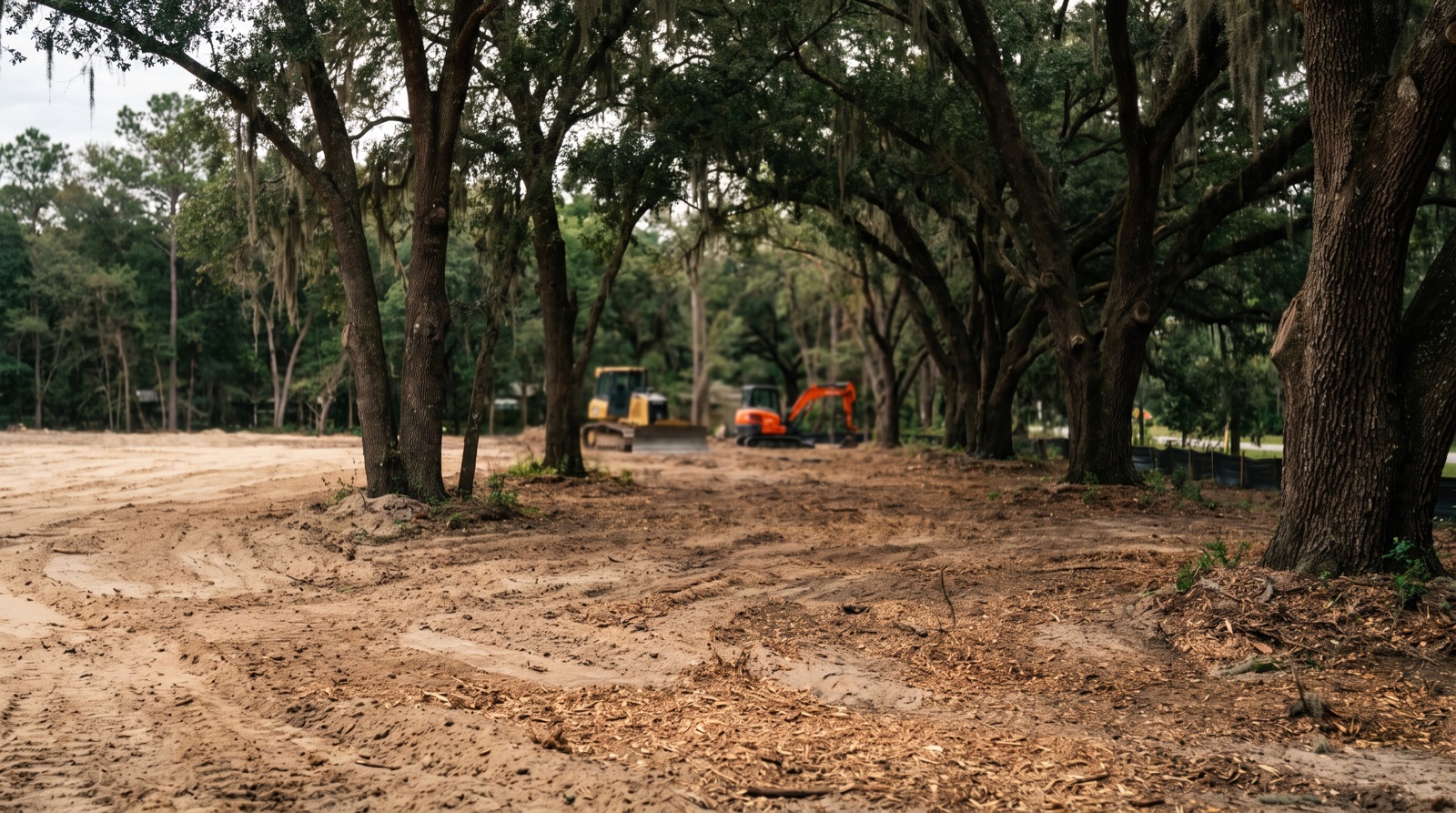
Land clearing in Jacksonville is priced by the scope and acreage — light brush clearing may run roughly $1,500–$3,000 per acre, while heavily wooded lots with large trees and stumps cost more. Selective or full clearing, stump grinding, debris haul-off, and rough grading are available. Note: wetlands and protected zones may need permits. Free on-site estimate.
Whether you're breaking ground on a new home, adding a shop or pool, running a new fence line, or finally reclaiming a lot that's disappeared under years of scrub, land clearing is the first real step — and in Jacksonville it means dealing with big live oaks, slash pines, palmettos, and a tangle of undergrowth on soft, sandy soil. 904 Tree Service routes your job to a licensed, insured Jacksonville crew with the chippers, grapples, and grinders to open a lot up cleanly and leave it ready for the next trade.
What land clearing includes
A full clear is more than dropping trees. Depending on your lot and your goal, the work can cover any mix of:
- Tree removal — felling and sectioning everything from spindly pines to mature oaks, including the crane and rigging work when big trees sit tight to a boundary or an existing structure.
- Brush & undergrowth clearing — palmetto, vines, scrub, and saplings mulched or hauled so you can actually see and walk the parcel.
- Stump grinding — grinding stumps below grade so the pad is buildable and nothing works its way back up through a slab or driveway.
- Fence-line clearing — cutting a clean, straight corridor for a new fence, survey line, or property boundary.
- Debris haul-off — logs, limbs, and root balls chipped, loaded, and removed so you're not left with a burn pile problem.
- Rough grading — knocking down the high spots and leveling the cleared ground into a workable pad.
Clearing for a build, addition, or reclaimed yard
Most clearing jobs on the First Coast fall into a handful of buckets. New construction is the big one — a wooded lot has to be opened and roughed in before a foundation crew can set foot on it. Beyond a full house pad, we regularly clear ground for pole barns and detached shops, for pools and screen enclosures that need the back corner of a yard opened up, and for new fence lines where a straight, cleared corridor makes the fencing contractor's job faster and cheaper. The last common one is simply reclaiming an overgrown lot — an inherited parcel, a rental that got away from someone, or a side yard swallowed by palmetto and vines that you want back as usable space. Each of these has a different right answer on how much to take down, which is where selective versus full clearing comes in.
For typical prices on every service — removal, trimming, stumps, palms and storm work — see the full Jacksonville tree service cost guide.
Selective vs. full clearing
You don't always want to clear-cut. Selective clearing keeps the trees worth keeping — a specimen live oak, a shade canopy over where the patio will go, a screen of pines along the road — while everything else comes out. In Jacksonville a mature live oak is genuinely valuable: it adds property value, drops summer cooling costs, and can't be replaced in your lifetime, so it's usually worth designing the build around one rather than losing it. Full clearing takes everything down to open ground, which is the right call when the entire footprint is going under a structure, driveway, or graded pad, or when the existing trees are diseased, storm-damaged, or too close together to keep safely. A good crew will walk the lot with you and flag which trees are keepers before a single cut is made.
Permits, wetlands, and protected areas — check first
This is the part to get right before anything comes down. For a typical single-family lot, residential tree removal is generally permit-light in Jacksonville under Florida HB 1159 — more on that at do I need a permit to remove a tree in Jacksonville. But larger clearing jobs are a different animal. Bigger acreage, commercial and multi-family parcels, and any land touching wetlands, mangroves, or protected and conservation zones can require permits, buffers, or environmental review before work begins — and clearing the wrong area can mean real fines and restoration orders. The crew helps identify what applies to your specific parcel during the on-site estimate and points you to the right agency, but final permitting and wetland delineation run through the proper channels. This is not legal advice — treat it as a reason to ask early, not a guarantee that your lot is permit-free.
Ready to open up your lot?
Get a licensed, insured Jacksonville crew out to walk the parcel, flag any zones that need a closer look, and put a real number on clearing, grinding, haul-off, and grading.
Call (904) 371-6603Sandy soil and stumps
Jacksonville's sandy soil cuts both ways on a clearing job. It lets shallow-rooted pines and oaks lean and topple in wind, so overgrown lots often hide leaners and hollow trunks that need to come out anyway — but that same loose, sandy ground makes stump grinding faster and cleaner than the clay you'd fight further inland. Grinding every stump below grade is what turns a "cleared" lot into a genuinely buildable one; leave them in and they rot, settle, and heave slabs and driveways for years. If your job is mostly about getting rid of stumps left behind from an earlier clear, see stump grinding — otherwise it's folded right into the clearing scope.