Orange Park's mature live oaks and tall pines near Doctors Lake need licensed, insured local crews for removal, trimming, stumps, and 24/7 storm work. Removal runs roughly $500–$6,000+ and trimming starts around $500, with free estimates. Residential hazard removals need no permit when an arborist documents it under Florida HB 1159, and Clay County crews work under a local business tax receipt and insurance.
Orange Park is a Clay County town, not part of Jacksonville — but it sits right on the west bank of the St. Johns and shares the same 904 canopy, so the tree work is the same story with a local address. Whether you're off Kingsley near the older village core, out toward Doctors Lake, or in one of the newer subdivisions west of Blanding, you're living under some serious trees, and that's exactly why a real crew matters here.
Orange Park's trees
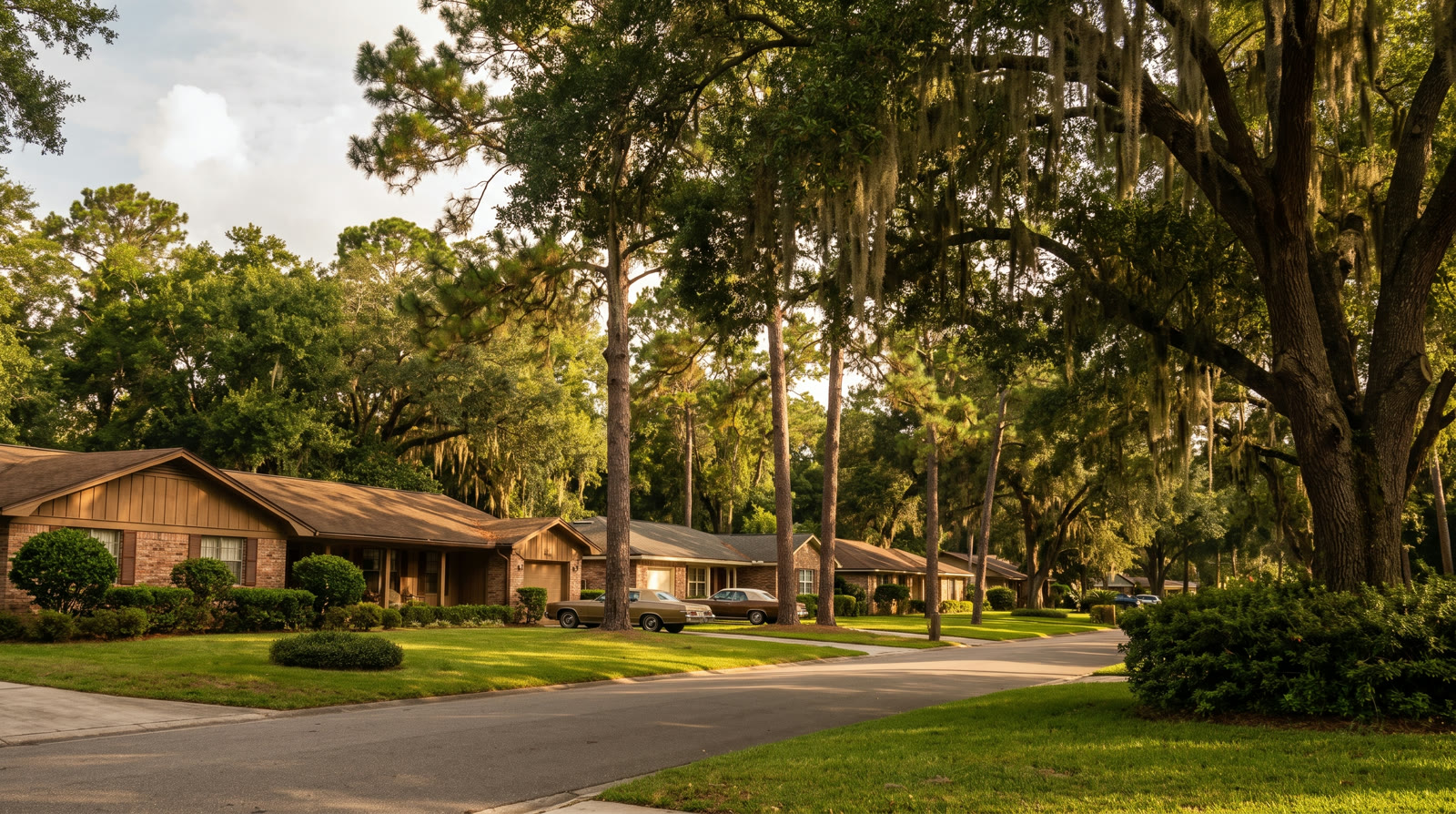
This is an established Clay County suburb strung along Doctors Lake and the St. Johns River, and the tree cover shows it. Mature Southern live oaks arch over ranch homes and two-story houses alike, their limbs reaching well past the trunk and often right over a roofline. Tall slash and longleaf pines tower above the oaks, and water oaks — faster-growing and shorter-lived — fill in a lot of the older yards. The pattern we see most in Orange Park is a big pine or two standing close to the house, and lakeside lots where trees lean out over the bulkhead and the water. All of it looks great until the wind picks up, and then that same size and proximity is the whole problem.
Tree services we cover in Orange Park
Every job routes to a licensed, insured local crew. Here's what they handle across Clay County:
- Tree removal — hazardous, leaning, or dead trees, including large oaks and pines that need a crane to lift clear of the house.
- Tree trimming & pruning — deadwooding, canopy thinning, and clearing limbs off your roof, lines, and the driveway.
- Stump grinding — grinding what's left below grade; Clay County's sandy soil actually makes this faster.
- Emergency & 24/7 storm service — a crew dispatched around the clock when a tree is on the house or blocking the drive.
- Storm damage cleanup — full-property debris haul-off with photos and documentation for your insurer.
- Palm tree service — trimming, skinning, and removal for the cabbage palms all over the neighborhood.
- Land & lot clearing — clearing lots, fence lines, and overgrowth for builds and projects.
These ranges hold across the 904 — for the full breakdown of what moves the number, see our Jacksonville tree service cost guide.
Storm season in Clay County
Hurricane season runs June through November, and Orange Park catches it two ways. The obvious one is the tropical systems that push up the peninsula; the quieter one is the open water. Wind coming off Doctors Lake and the St. Johns River has no canopy to slow it before it hits your yard, so lakeside and riverfront trees take the full load. Add the region's sandy, easily saturated soil — when it's soaked from days of rain, it loses its grip on shallow-rooted pines, and a tree that stood for forty years can topple in a gust that a clay-anchored tree would shrug off. The move is to get ahead of it: pre-season pruning to reduce the sail area of big canopies and take down the obvious hazards before a named storm forces the issue. Booking that work in spring beats calling every crew in the county at once after the wind hits.
Big pine leaning toward the house?
Don't wait for the next storm to decide it for you. Get a licensed, insured Clay County crew out for a free look and a written estimate.
Call (904) 371-6603Permits & insurance in Orange Park
For most homeowners the permit answer is simpler than you'd think. Under Florida HB 1159, a tree on residential property can be removed without a local permit when a certified arborist provides written documentation that it's a hazard, and routine trimming or pruning needs no permit at all. Commercial, multi-family, and protected areas like wetlands can still require approval, so confirm before large work — the full breakdown is on our tree permit guide.
On the licensing side, Florida doesn't issue a statewide tree-contractor license, so a legitimate Clay County crew works under a local business tax receipt plus liability and workers' comp insurance — that's the paperwork to ask for, and every crew we route to carries it. Insurance matters after a storm too: homeowners policies generally cover removal when a storm-fell tree lands on an insured structure like your roof, fence, or car, though a healthy tree that drops in the open yard usually isn't covered. Either way, crews document the scene with photos and a written scope so you have what your adjuster needs.