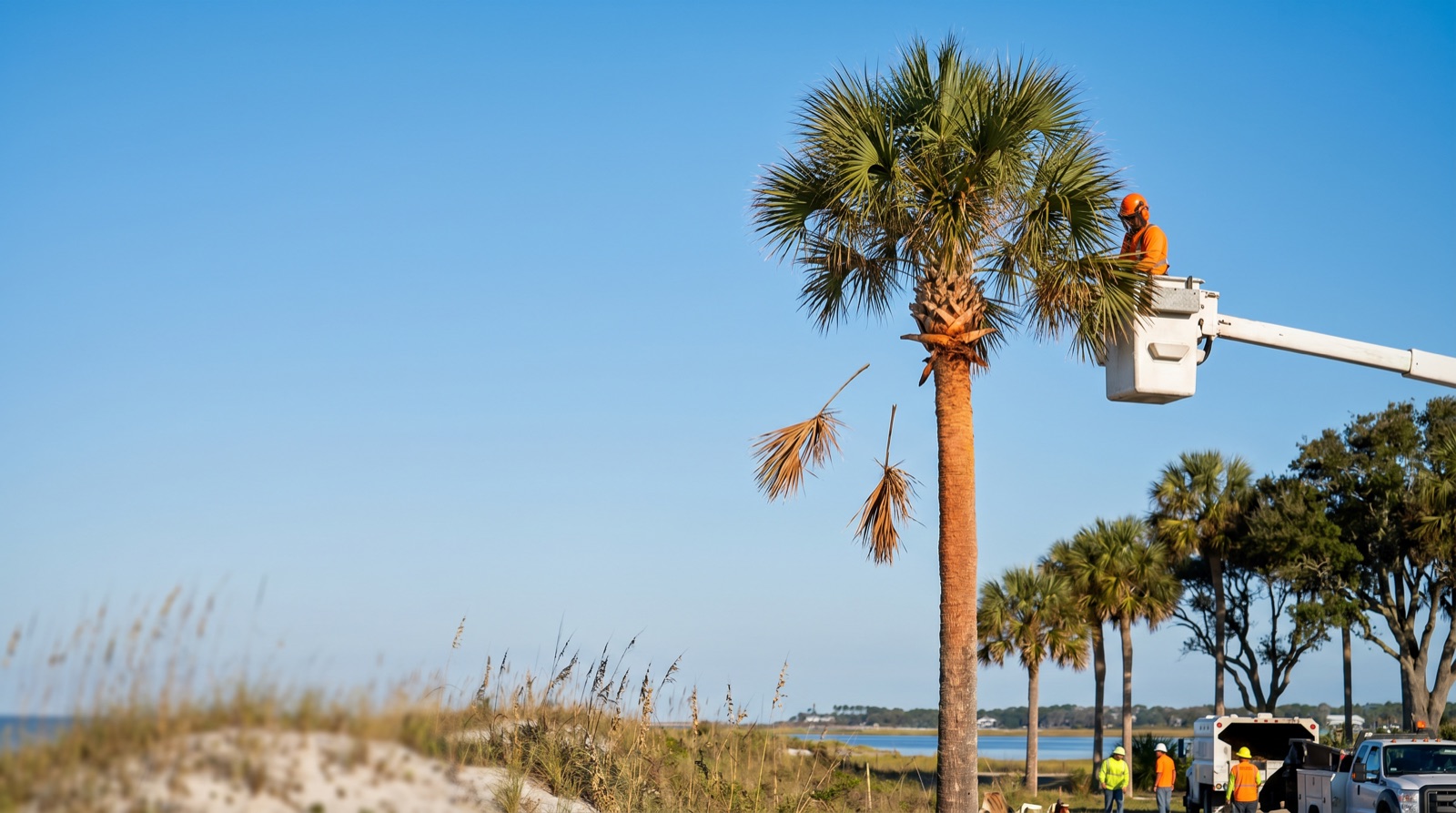
Palm trimming in Jacksonville typically runs about $75–$400+ per palm depending on height and access — tall or hard-to-reach palms cost more. Cabbage palms, Florida's state tree, grow everywhere here. Avoid the over-cut "hurricane cut," which stresses the palm — see hurricane tree prep for what actually helps. Trimming, skinning, seed-pod removal, and full removal are all available, with a free estimate.
Palms are what make a Jacksonville yard look like Florida — but they're not maintenance-free, and they're not pruned like an oak. A cabbage palm sheds fronds and drops heavy seed stalks; a queen palm throws long, messy flower and fruit clusters; ornamentals can starve for the right nutrients in our sandy soil. 904 Tree Service connects you with licensed, insured local crews who trim, skin, feed, and — when a palm is past saving — safely remove it, with the bucket trucks and climbing gear to reach the tall ones.
What palm service includes
Palm care covers more than a haircut. A typical visit can include any of the following, priced by height and access:
- Trimming dead and brown fronds — removing the drooping, fully brown lower fronds that hang below the horizontal, which are the ones that pose a falling hazard and harbor pests.
- Skinning old boots — cleaning the persistent leaf bases (the "boots") off the trunk of cabbage palms for the smooth, finished look many homeowners want.
- Removing seed pods and flower stalks — cutting off the heavy fruit clusters and flower stalks before they drop, sprout volunteers, or attract rats and roaches.
- Health and nutrient care — spotting the yellowing that signals a potassium or magnesium deficiency common in Florida's sandy soil, and recommending the right palm fertilizer instead of just cutting.
- Removal and storm cleanup — taking down palms that are dead, diseased, or storm-shredded, and clearing the fronds and debris a windstorm leaves behind.
Cabbage palms and Jacksonville's palms
The cabbage palm (Sabal palmetto) is Florida's state tree, and it's everywhere across the 904 — in yards, along fence lines, and lining streets from Riverside to the Beaches. It's tough, salt-tolerant, and hurricane-hardy, but it grows tall fast and drops big seed stalks and boots that most owners want kept in check. Alongside it you'll find queen palms, prized for their feathery canopy but heavy droppers of dates and flower stalks; Washingtonia (Mexican and Washington fan palms), which get very tall and shed long skirts of dead fronds; and a range of ornamentals — pindo, sylvester, foxtail, and clumping palms — that homeowners plant for curb appeal. Each is pruned a little differently, and a crew that knows Florida palms won't treat a delicate ornamental the way it treats a rugged cabbage palm.
For typical prices on every service — removal, trimming, stumps, palms and storm work — see the full Jacksonville tree service cost guide.
Don't over-trim: the "hurricane cut" myth
The most common mistake in Florida palm care is the "hurricane cut" — stripping the canopy back to just a few upright fronds so the palm looks like a rocket or a feather duster. It's popular because people assume a bare canopy is safer in a storm, but it's the opposite of good for the tree. Green fronds are how a palm makes its food; cutting healthy ones off starves the palm, stresses it, and slows its growth, and the fresh wounds can invite pests and disease and leave it weaker — not stronger — going into hurricane season. The rule good crews follow: remove only dead and dying fronds, and don't cut above the horizontal — roughly no higher than the 9-and-3 line you'd read on a clock face. Leave everything pointing up and out; take only what's brown and hanging down.
Palm diseases to watch in NE Florida
A palm that's thinning, yellowing, or dropping fronds out of season isn't always a trimming problem — sometimes it's disease, and a few are serious in Northeast Florida. Ganoderma butt rot is a soil fungus that rots the base of the trunk; there's no cure, and an affected palm eventually has to come down. Lethal bronzing (a phytoplasma disease spread by insects) kills a range of palms and, as the name says, is fatal once it takes hold. Simple nutrient deficiencies — potassium and magnesium especially — also yellow the fronds and can look alarming without being deadly. Because the symptoms overlap and some of these have no fix, the right first step is a look from a certified arborist who can tell disease from hunger. One practical note that matters: pruning tools should be sanitized between palms, since dirty blades can carry disease from a sick tree to a healthy one.
Palm looking rough — or just overdue?
Get a licensed, insured crew out for a free estimate. Whether it needs a proper trim, a skinning, a feeding, or an honest assessment, you'll know what it actually needs before anyone climbs.
Call (904) 371-6603When a palm needs to come down
Not every palm can be saved, and a few shouldn't be. A palm that's dead or dying from disease, one that's been storm-damaged beyond recovery, or one that was planted too close to the house, the pool, or a driveway is usually a removal, not a trim. The good news for cost: palms have a shallow, fibrous root ball rather than a deep hardwood taproot, so removal and stump grinding tend to go faster than an oak of the same height. If you're weighing it, the crew can price both the trim and the takedown so you can choose. See tree removal for how removals work and what they run.
Storm and hurricane frond cleanup
When a summer squall or a named storm rolls through, palms are often the first thing to shed — a yard can be buried in fronds, boots, and seed stalks by morning, even when the palm itself is fine. Crews handle that debris as part of storm work: fronds and litter hauled off, any snapped or leaning palms assessed, and the mess cleared so you're not raking for a week. During hurricane season (June through November) this is one of the most common calls we route. For the full-property version — trees, limbs, and debris after a big blow — see storm damage cleanup.