In Florida, when a healthy tree falls in a storm, the damage is treated as an act of God — each owner's own insurance covers their own property, no matter whose yard the trunk stood in. Liability shifts to the neighbor only when the tree was dead, dying, or visibly hazardous and they knew or should have known. Either way, a tree on a structure is a 24/7 emergency call.
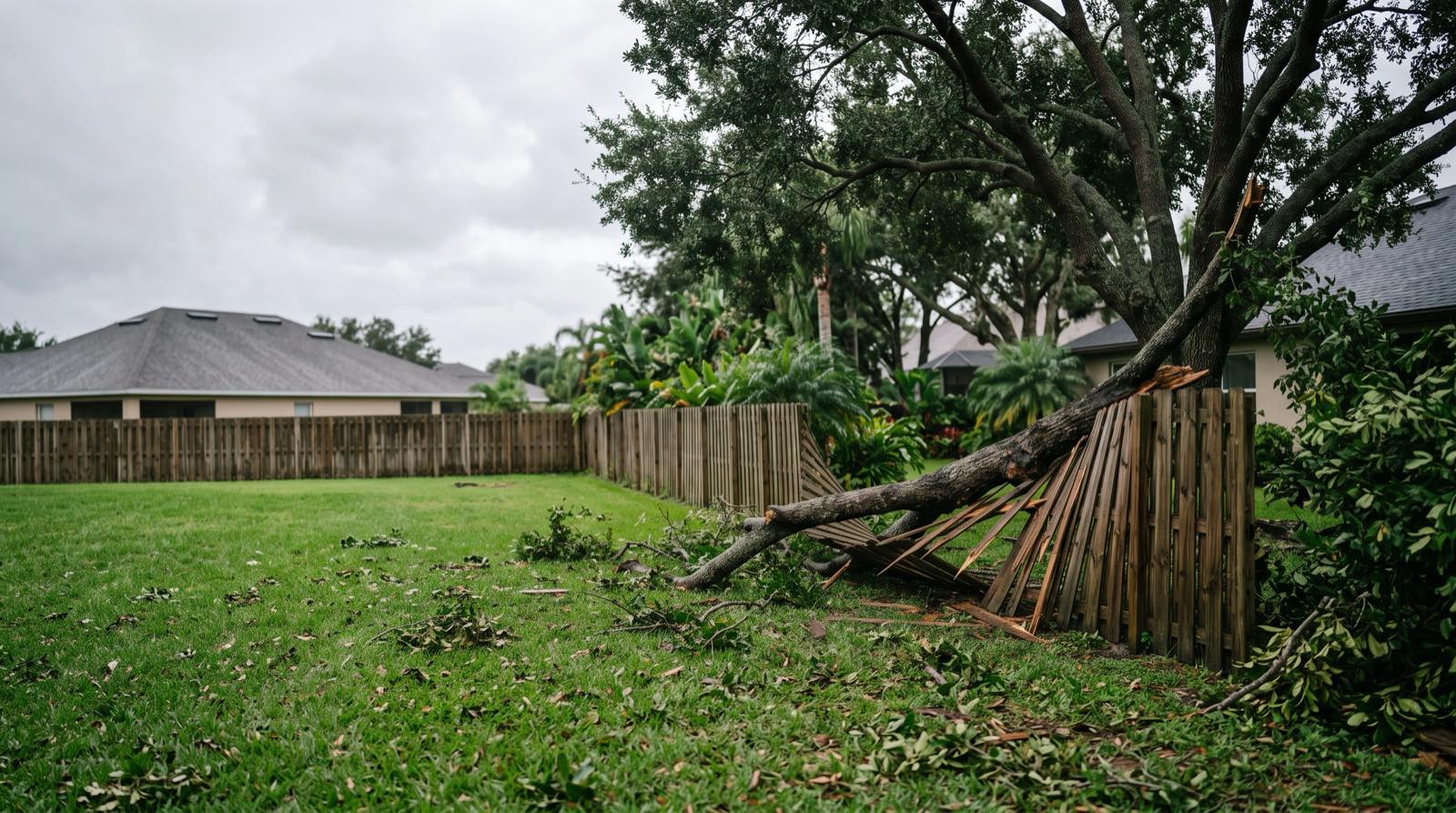
It's one of the most common calls after any Jacksonville windstorm: half of a water oak is lying across the fence, the shed, or the back of the house — and the trunk is rooted next door. Before anyone knocks on a door angry, it helps to know that Florida has a fairly settled way of sorting this out, and it usually has less to do with property lines than people expect.
The Florida rule: health beats geography
Florida courts follow what's often called the healthy-tree rule. If a living, apparently sound tree comes down in wind, rain, or a hurricane, the law treats that as an act of God. Nobody is "at fault" for weather, so each property owner looks to their own insurance for their own damage — your fence and roof are your policy's problem, the neighbor's crushed shed is theirs, even though it was their tree. The leading Florida case on point, Gallo v. Heller, put it plainly: a landowner isn't liable to neighbors for damage caused by a healthy tree doing what trees naturally do.
The flip side is just as important. If the tree was dead, dying, decayed, or obviously hazardous — and the owner knew or reasonably should have known — letting it stand can be negligence. Then the owner (and practically speaking, their liability coverage) can be on the hook for what it destroys when it finally goes.
What "should have known" looks like
Negligence cases turn on visible warning signs a reasonable owner would have acted on:
- A standing dead tree. Bare in June, bark sloughing off, woodpecker holes — no leaves in a Jacksonville summer is not subtle.
- Visible decay. Mushroom conks at the base, hollows, carpenter ants streaming from the trunk.
- A major lean that appeared recently, or soil lifting on one side of the roots.
- Prior warnings. A letter, an email, even a text saying "your oak is dead and hanging over my driveway" — that's exactly the notice that turns weather damage into negligence.
That last point cuts both ways. If a neighbor's tree worries you today, put your concern in writing and keep a copy, ideally with photos. If it ever falls, the question of what they knew is already answered. Our guide to the signs a tree is dying or dangerous covers exactly what to look for and photograph.
How the insurance actually works
A few practical points that surprise homeowners every storm season:
- Your policy pays for your structures — house, garage, fence, pool screen — regardless of whose tree hit them. You file with your own carrier; if the neighbor was truly negligent, your insurer can chase theirs (subrogation) after paying you.
- Removal is usually covered only when a structure is hit. Most policies pay to get the tree off the house and repair the damage. A tree that lands harmlessly in the middle of the lawn is often subject to a small debris cap — commonly in the range of $500–$1,000 — or nothing at all.
- Cars follow the car's insurance. A tree on your vehicle is a comprehensive auto claim, not a homeowners claim — again, regardless of whose tree it was.
- Documentation decides claims. Dated photos before anything is moved, plus a written removal estimate, are what your adjuster needs. Crews here shoot that documentation as a standard part of storm damage cleanup — and our guide to tree removal insurance coverage walks through the whole claim.
Tree on the house right now?
Don't wait for the liability question to settle — a tree on a structure keeps doing damage with every gust, and tarping can't start until it's off. We dispatch licensed, insured crews 24/7 across the 904, and they document the scene for your claim as they work.
Call (904) 371-6603Who removes it — and from which side
Ownership of the mess follows the property line, not the trunk. The portion of the tree lying on your land is generally yours to remove (through your insurance, if a structure was hit), and the portion on the neighbor's side is theirs — even when it's one tree. In practice, the cleanest outcome is usually one crew handling both sides in one mobilization with each owner's insurer billed for their share; it's cheaper than two crews and two cranes doing half a job each. See 24-hour emergency tree service for how a tree gets lifted off a structure safely, and tree removal for taking down what's left standing.
If the tree hasn't fallen yet
You have more options — and more leverage — before gravity gets involved. Florida lets you trim branches and roots back to your property line at your own expense. For the whole tree, the move is a written heads-up to the owner, backed by a certified arborist's assessment if the hazard is real. Under Florida's HB 1159, a documented hazard tree on residential property can be removed without a city permit — so once the owner agrees, there's very little red tape left.
This is general information, not legal advice.
Liability disputes are fact-specific, and nothing here substitutes for a Florida attorney's opinion on your situation. What we can do is handle the tree: assessment, documentation, and safe removal by licensed, insured local crews.