The big red flags: mushroom conks at the base, a canopy that's thinning or didn't leaf out, large dead limbs, bark falling away in sheets, a new lean, cracks in the trunk, soil lifting over the roots, and woodpecker or carpenter-ant activity. One sign means get it assessed; a new lean or lifted root plate means call now. A certified arborist's written assessment settles keep-or-remove — and under HB 1159 it's also what makes a hazard removal permit-free.
Trees rarely fall out of nowhere. Between Jacksonville's storm seasons, most failures are the last chapter of a story that's been visible for months — sometimes years — to anyone who knew what to look for. This is the homeowner's version of what an arborist checks, top to bottom.
The eight signs, ranked roughly by urgency
1. A new or worsening lean
Trees can live happily with an old lean they grew into. What's dangerous is change: a tree that was straighter last month, or a lean that visibly worsens after a wet, windy week. In our sandy soil, that usually means the roots are losing their grip — treat it as urgent.
2. Soil lifting or cracking over the roots
Look at the ground on the side opposite the lean. A mound of raised soil or turf cracking in an arc means the root plate itself is hinging — the tree is failing at the ground, and the next serious blow can finish it. This is the closest thing a tree has to an alarm bell. Call the same day.
3. Mushrooms or conks at the base
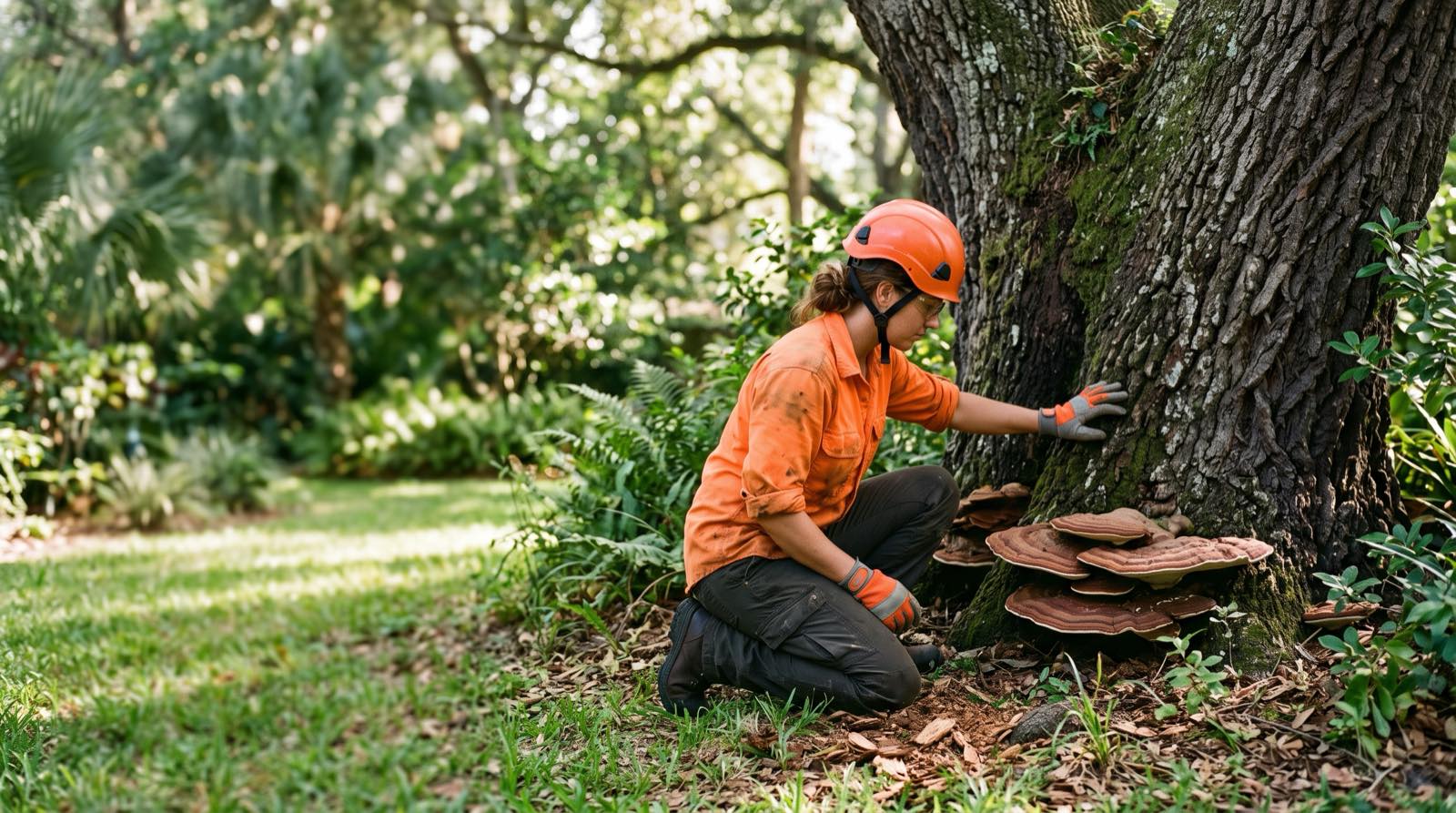
Fungal fruiting bodies — shelf-like conks, clusters of mushrooms — on the trunk, the root flare, or the ground right at the base are the visible tip of internal decay. Ganoderma conks on oaks are a Jacksonville classic. The wood can be structurally hollow while the canopy still looks green, which is exactly why this one fools people.
4. A canopy that's thinning, browning, or didn't leaf out
Live oaks here swap leaves in spring and can look briefly scruffy — that's normal. What isn't: whole sections that stay bare into summer, leaves browning out of season, or a canopy that gets visibly thinner every year. Dieback that starts at the top (crown dieback) often traces to root damage or disease below.
5. Large dead limbs — "widow-makers"
Big, bark-shedding dead branches hung up in the canopy are a hazard all by themselves, whatever the rest of the tree is doing. Over a driveway, a play area, or a roof, they're a pruning call before they're anyone's diagnosis question.
6. Bark falling away in sheets
Bark naturally sheds in small flakes; it does not naturally slough off in slabs leaving smooth dead wood exposed. On pines, check for sawdust-like frass and pitch tubes too — bark beetles finish what stress starts, and a beetle-killed pine gets brittle fast.
7. Cracks, seams, and splitting unions
A vertical crack in the trunk, or a tight V-shaped fork where two leaders press against each other (included bark), is a structural fault line. Water oaks — everywhere in Jacksonville's older neighborhoods — are notorious for splitting at exactly these unions in middle age.
8. Woodpeckers, carpenter ants, and hollows
Wildlife reads a tree's condition before you do. Heavy woodpecker work, carpenter ants trailing from a cavity, or an open hollow all say the same thing: there's dead, soft wood inside this tree. One small cavity isn't a death sentence — a live oak can wall off a hollow for decades — but it belongs on an assessment list.
Two or more signs on the same tree?
That's no longer a watch-and-wait situation. Get a licensed, insured crew to look at it — the on-site assessment is free, and if it's a genuine hazard the arborist documentation makes the removal permit-free under HB 1159.
Call (904) 371-6603Dying vs. dangerous — they're different questions
A declining tree isn't automatically a hazard, and a hazardous tree isn't always dying. A half-dead oak in a back corner over nothing but grass can often be left for the woodpeckers; a perfectly green water oak with included bark over a bedroom is the more urgent problem. Risk is condition × target — what would it hit? That's the calculus a tree risk assessment puts in writing, and it's why the answer isn't always "remove it." Sometimes it's a structural prune, a cable, or genuinely nothing.
Why this matters double in Jacksonville
Two local multipliers. First, hurricane season: a tree carrying any of these defects in May is a different risk by September, and crews' calendars fill fast once a storm is named — the cheap, calm time to act is before June. See hurricane tree prep for the pre-season checklist. Second, liability: once a defect is visible, you're on notice. If a tree you knew was failing lands on the neighbor's garage, that's a negligence claim, not an act of God — and the same photos that would have justified removing it become the evidence against you.
What happens when you call
Describe the tree and what you're seeing. A local crew looks at it in person — free — and tells you straight whether it's a prune, a removal, or a false alarm. If it's a hazard, the written arborist documentation is arranged as part of the job and the removal is scheduled, with no city permit needed for a documented residential hazard under Florida HB 1159.