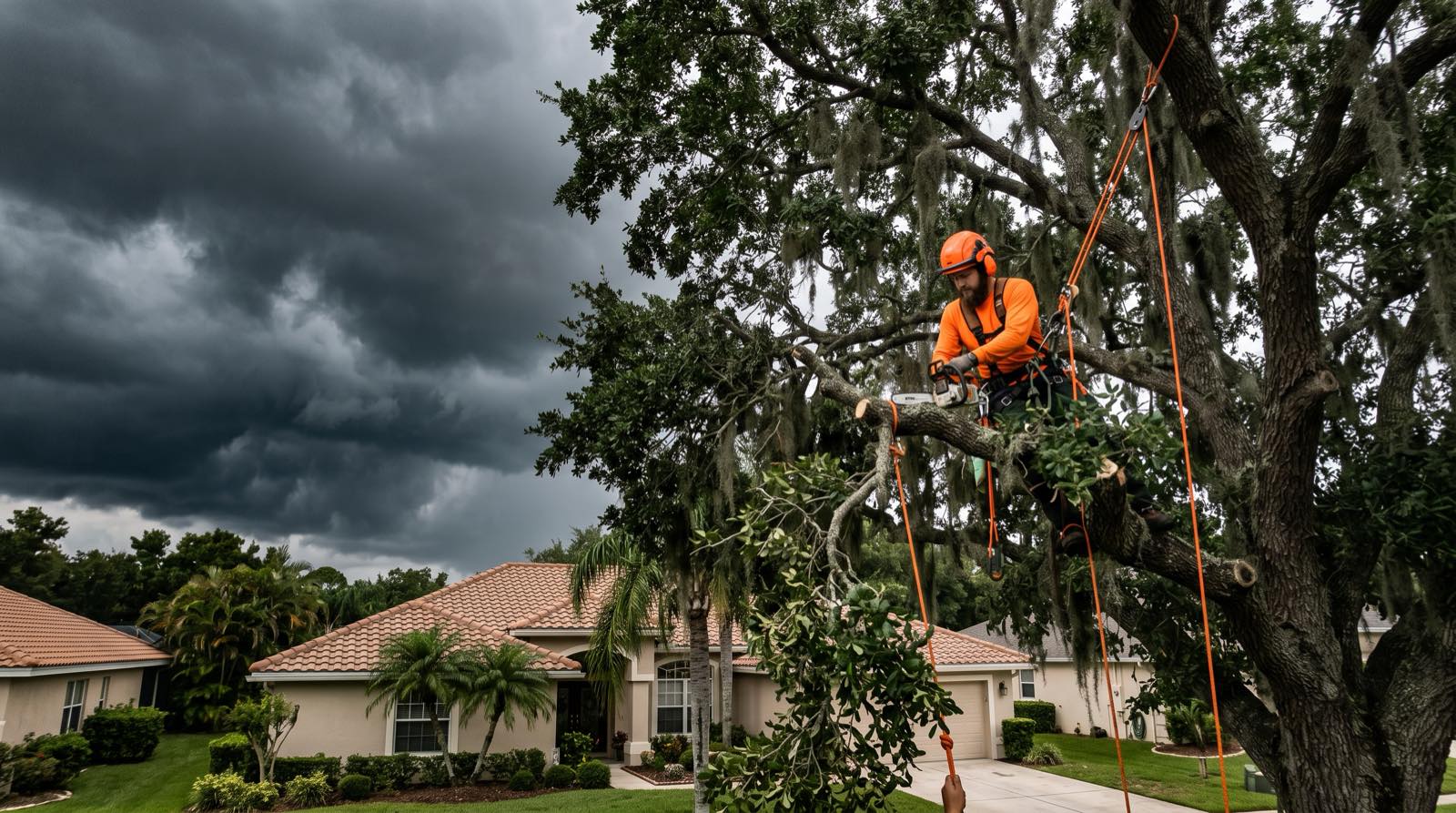
Real hurricane prep is three moves, done before June: a structural prune that thins the canopy so wind passes through, removal of the trees that shouldn't see another season — dead, decayed, badly leaning — and clearance of limbs off the roof and lines. What it is not is topping or over-stripping, which make trees more likely to fail. Prices and calendars are both better in spring than in September.
Every Jacksonville homeowner knows the season: June 1 to November 30, with the local peak from late August through October. What separates the yards that shrug off a tropical storm from the ones with a pine through the lanai is rarely luck. It's whether anyone looked at the trees in spring, when there was still time to do something calm about them.
Move one: structural pruning — thin it, don't top it
Wind doesn't knock trees over so much as it catches them. A dense canopy is a sail; the goal of storm pruning is to let wind pass through the canopy instead of loading it. A proper structural prune:
- Thins interior growth selectively, reducing the sail without stripping the branch structure that dampens sway.
- Removes deadwood — every dead limb is a projectile waiting for a gust.
- Shortens over-extended limbs reaching over the roof, and raises clearance off shingles and service lines.
- Corrects weak unions — the tight V-forks with included bark that split first in a blow.
Keep it moderate: taking more than roughly a quarter of the live canopy in one season stresses the tree and triggers exactly the weak regrowth you don't want. The full menu — deadwooding, thinning, roof and line clearance — is covered under tree trimming & pruning.
What NOT to do: topping and lion-tailing
Two "storm cuts" still get sold around Florida every spring, and both backfire:
- Topping — beheading the main leaders — feels like less tree to blow over. What grows back is a broom of fast, weakly-attached shoots on decaying stubs: more sail on worse anchors within a couple of seasons.
- Lion-tailing — stripping all interior growth and leaving foliage only at branch tips — moves the whole wind load to the end of the lever arm. It's how storm-pruned trees still snap.
If a quote involves "topping it for the season," keep dialing. A crew that knows Northeast Florida storms will talk about thinning and structure instead.
Move two: the trees that shouldn't see another season
Pruning helps a sound tree. It does nothing for a tree that's already failing — and hurricane season is the worst possible stress test. Walk the yard in spring and be honest about anything showing the classic warning signs: standing deadwood, conks at the base, a fresh lean, lifted soil over the roots, big cracks. Special local attention to:
- Water oaks past middle age. Fast-grown, decay-prone, and famous for coming apart at 40–60 years old — they fill Jacksonville's prewar neighborhoods and they fill the post-storm damage reports too.
- Tall pines near structures. Slash and loblolly pines snap mid-trunk in sustained wind, and saturated sandy soil lets whole root plates roll. A leaning pine within striking distance of the house is a spring decision, not a September one.
- Anything an arborist already flagged. A documented hazard is also permit-free to remove on residential property under HB 1159 — there's no red-tape reason to wait.
Pre-season removal is planned, orderly, and priced like normal work. The same tree removed off your roof in September is an emergency, at emergency stakes.
The cheap window is April–May.
Once a storm is named, every crew in the 904 books out and the work shifts from prevention to triage. A free spring estimate sorts your trees into prune / remove / leave alone while all three are still easy options.
Call (904) 371-6603Palms: mostly leave them alone
The great Florida palm myth is the "hurricane cut" — shaving a cabbage palm down to a feather duster before the season. Palms are already the most wind-adapted thing in your yard; sabal palms ride out hurricanes that snap oaks. Over-stripping green fronds weakens the palm and removes the buffer protecting its one growing point. Real palm prep is modest: remove dead, hanging fronds and seed pods that become debris, and stop there. Details under palm tree service.
The pre-season checklist
The whole guide, condensed. Work through this before June 1 and you've done more than most of the neighborhood:
- Walk the property and flag every tree within falling distance of the house, driveway, or power drop.
- Check the red flags: standing dead wood, mushrooms or conks at the base, a new lean, cracks at trunk unions, a lifted root plate — see signs a tree is dying.
- Book structural pruning for the keepers — thin the canopy, remove deadwood, clear the roofline. No topping. See tree trimming.
- Remove the non-survivors now — the dead pine and the failing water oak come down at planned rates in spring, not emergency rates in September. See tree removal.
- Leave healthy palm fronds alone — green fronds are the palm's storm armor; only dead fronds and coconuts need to go.
- Photograph your trees and property once prep is done — dated "before" photos strengthen any later claim, and our guide to tree removal insurance coverage explains what adjusters look for.
- Save the 24/7 line — (904) 371-6603 — because when the wind wins anyway, emergency dispatch answers around the clock.
The week the cone appears
Too late for pruning — major cuts right before a storm leave fresh wounds and unbalanced canopies. The useful last-minute list is short: clear yard debris and existing limb piles (anything loose becomes airborne), photograph your trees and property for the before record, and get any already-hanging limb over the house dealt with as a priority call.
After the storm: triage order
When it's passed, work the sequence — it's built around the ways people get hurt after hurricanes:
- Anything near a downed line: stop. That's JEA's call first, nobody else's.
- Tree on the house? Photos first, then a 24/7 emergency crew — the tarp can't go on until the tree comes off, and every rain band does more damage.
- Leaners and hangers — trees resting on other trees, half-detached limbs overhead — are the classic post-storm injury. Crew work, not chainsaw-weekend work.
- Everything else is just debris. Storm cleanup hauls it, with the dated photos and written estimate your insurer wants. Whose insurance pays for a neighbor's fallen tree is its own question — answered here.