
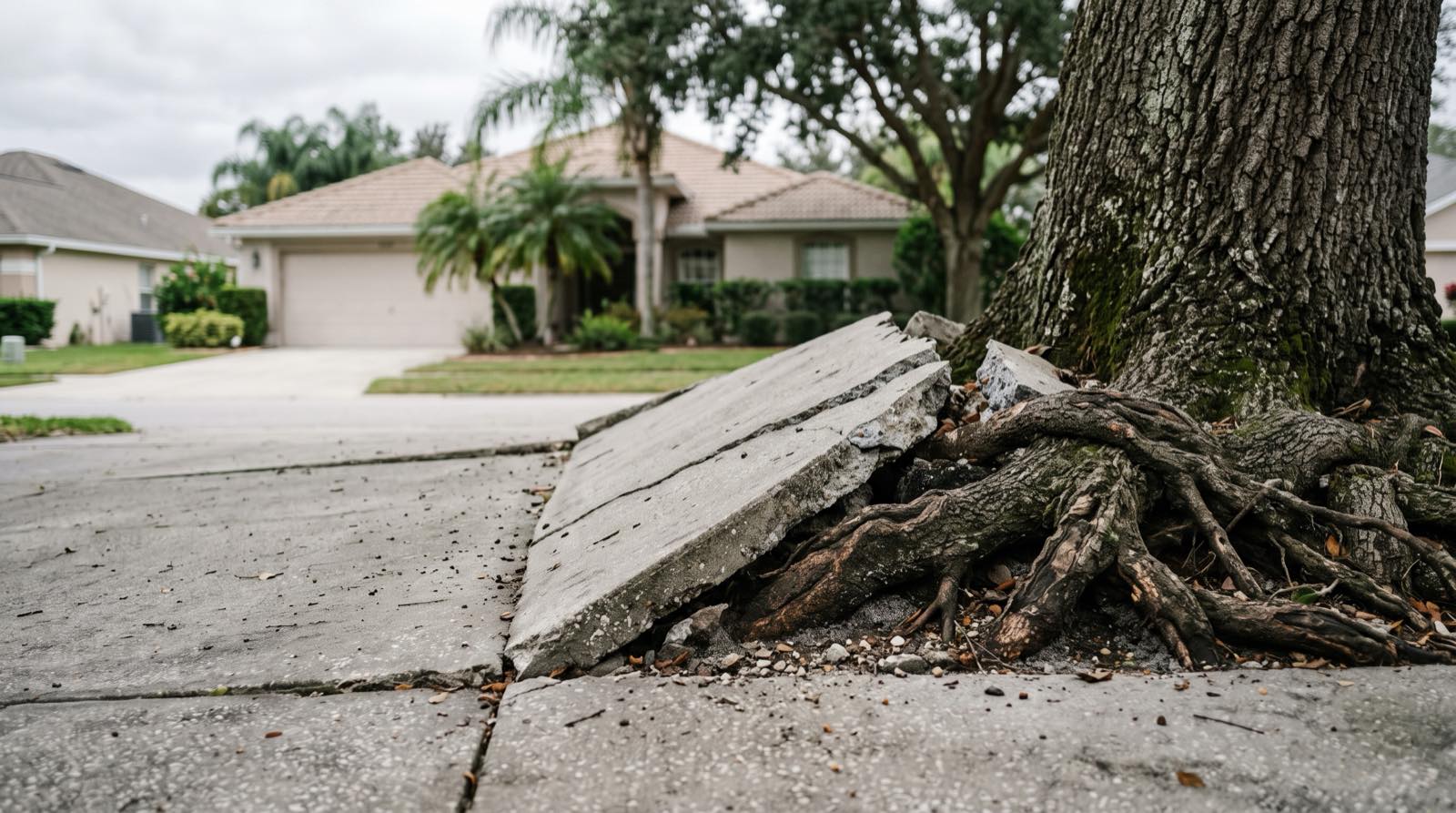
In Jacksonville's sandy soil, tree roots rarely break foundations directly — the classic damage is lifted driveways, walkways, and pavers, and roots exploiting already-broken sewer pipes. Safe fixes exist: cutting small surface roots at the slab, root barriers for the long term, or re-routing hardscape. The hard rule: never cut major roots close to the trunk — that destabilizes the tree. When the offending root is structural, the honest conversation is about the tree, not the root.
Every older Jacksonville neighborhood has the same sidewalk: a slab tilted up like a drawbridge with an oak root underneath it. Roots and concrete have been fighting here for a century, and concrete keeps losing. But before you declare war on the root — or the tree — it's worth knowing what roots actually do, because the standard fears are about half right.
Foundations: mostly myth, with real exceptions
Start with the good news: roots almost never crush or pierce a sound foundation. A root meeting your footing doesn't drill in — it deflects and grows along it. The horror stories mostly come from clay-soil regions, where roots dry the clay and the shrinking soil drops the foundation. Jacksonville's sandy soil doesn't shrink, which quietly removes the main way trees hurt houses elsewhere.
The real local exceptions are narrower: a root growing tight against a shallow slab edge can lift a corner of a porch, stoop, or garage apron as it thickens; and a large tree very close to the house — trunk within a few feet — can move footing-adjacent soil as the root flare expands. Cracks in drywall over doorways usually have another cause entirely, but a tree fitting that close-in profile deserves a professional look rather than a guess.
Driveways and walkways: the real battlefield
This is where the damage genuinely happens. Surface roots thicken over decades and act like slow hydraulic jacks under anything rigid. Sandy soil accelerates it — roots run shallow here because the water and oxygen are near the surface, exactly where your concrete is. Your realistic options, cheapest first:
- Live with it, safely. Grind the lip of a lifted joint or ramp it with asphalt — fine for minor heave on a walkway you're not replacing soon.
- Cut the offending root — if it's small and far enough out. The working rule of thumb: cutting is generally tolerable when the root is only a few inches thick and you're at least 3–5 times the trunk's diameter away from the tree (for a 2-foot-thick oak, that's 6–10 feet minimum). Closer or bigger, and you're cutting the tree's anchor — see below.
- Install a root barrier. Cut the root at the slab line, then set a vertical HDPE barrier 18–24" deep along the pavement edge. Roots dive under it and stay down long enough to spare the new slab. This is the standard fix when the concrete is being replaced anyway.
- Reroute or switch materials. Curving a new walkway around the root zone, or using pavers (liftable, re-settable) near a grand tree, beats fighting the same root every eight years.
The rule that keeps trees standing: don't cut close
Roots aren't plumbing — they're the anchor. The big woody roots within a few feet of the trunk hold the tree up, and severing one on the windward side can turn a healthy oak into a leaning hazard in one storm. Worse, the failure often comes years later, when nobody connects it to the trench. The practical rules: stay outside 3–5 trunk diameters, never cut more than one major root in a season, and if the root you'd need to cut is structural — thick, close, load-bearing — the question isn't "how do I cut this root," it's "is this tree in the right place?" That's also why trenching for irrigation, utilities, or footers through a root zone should get arborist eyes before the backhoe, not after the oak starts tipping. Root damage you cause is also on you if the tree fails into the neighbor's yard — the liability logic from our fallen-tree guide applies.
Before anyone cuts a root —
Get a free on-site look. A crew can tell you in ten minutes whether that root is expendable plumbing or the thing holding the tree up, and quote the barrier, the cut, or the removal honestly.
Call (904) 371-6603Sewer lines: roots are the looters, not the burglars
The pipe myth deserves its own correction: roots don't break healthy pipes. They find water and oxygen leaking from a joint that has already failed — common in the clay and cast-iron laterals under Jacksonville's older neighborhoods — and follow the leak in. Once inside, they mat into a net that catches everything (that part of the reputation is earned). Cutting the roots out of the line is a plumber's temporary fix; they regrow through the same defect. The durable fix is repairing or lining the pipe — a sound pipe with no leak attracts no roots. Removing a healthy tree to protect a broken pipe is backwards; fix the pipe.
When the answer really is the tree
Sometimes the honest math ends at removal: the wrong species planted a stride from the slab (laurel oaks and camphors in 1970s front yards, everywhere in Arlington and Southside), a root system that's already into its third driveway, or structural roots that can't be cut without creating a hazard. Then the sequence matters — remove the tree, grind the stump and surface roots (fast in sandy soil), let the ground settle, then pour the new concrete. Doing it in that order is the difference between a slab that lasts and doing this all again. A hazard documented by a certified arborist needs no city permit on residential property; real numbers for removal and grinding are in the cost guide.