Live oak care in one paragraph: prune in winter dormancy (roughly December–February here), remove no more than about 25% of the live canopy in any season, never top a live oak, leave the Spanish moss alone (it's harmless), and protect the root zone from trenching, fill dirt, and compaction. Mature live oaks are among the most hurricane-resistant trees in Florida — a healthy one is an asset, not a threat.
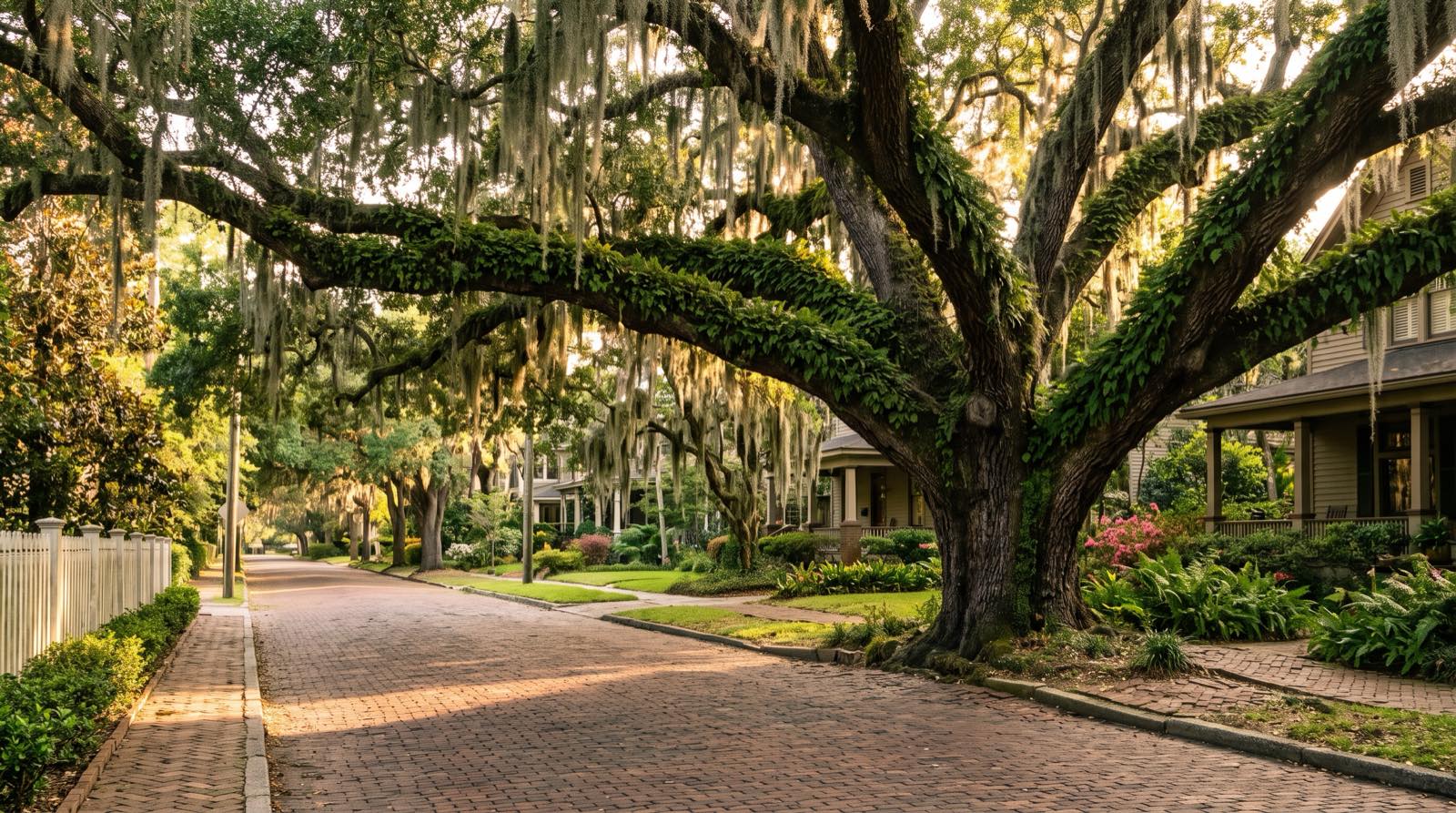
The Southern live oak (Quercus virginiana) is the reason Jacksonville's old neighborhoods look the way they do. They shade whole streets in Riverside and Avondale, they hold the riverbank at Mandarin, and some of them predate the city itself. They're also astonishingly tough — when hurricanes tear through Florida, the live oaks are usually the trees left standing. Caring for one is mostly a matter of not undoing what the tree already does well.
When to trim: winter, with exceptions
The ideal window for significant live oak pruning in Northeast Florida is dormancy — roughly December through February. The tree's energy is stored, growth has paused, and cuts made now seal quickly when spring pushes. It also puts structural work comfortably ahead of hurricane season. (Florida sits outside the Texas-style oak wilt zones that make summer pruning dangerous elsewhere, but winter remains the horticultural best practice here.) The exceptions that don't wait for December: deadwood, broken or hanging limbs, and anything rubbing the roof can and should be cut any day of the year.
One seasonal note that saves a panicked call every spring: live oaks are not evergreen, they're briefly-deciduous. Around February and March they drop their entire old leaf crop as the new one pushes in. A thin, littering oak in early spring is doing exactly what it's supposed to do.
How much to take: the quarter rule
Industry standard (ANSI A300) and common sense agree: remove no more than about 25% of the live canopy in one season — and for a mature live oak, the right number is usually much lower. Every green leaf is the tree's income; strip too many and it responds with exactly the panic growth you don't want — dense, weakly-attached sprouts — while decay gets a head start in the oversized wounds. Old oaks especially live on thin margins: a heavy "clean-out" that a young laurel oak would shrug off can push a 200-year-old live oak into a decline it never recovers from. Good crews take less than they could, not more.
Never top a live oak
Topping — cutting the main limbs back to stubs — is the fastest way to convert a live oak from asset to liability. The stubs decay (live oaks compartmentalize well, but not at that scale), the regrowth is a mat of weak sprouts, and the tree's signature architecture — those long, low, self-balancing limbs — never comes back. A topped live oak is structurally worse in five years and ugly forever. Any storm-prep argument for it is backwards; see why topping backfires in wind. If someone quotes you a topping job on a live oak, that's the whole interview.
The moss and the ferns are innocent
Two permanent residents of Jacksonville live oaks get blamed for every decline. Spanish moss is not a parasite — it's an air plant that takes nothing from the tree; heavy moss on a thinning oak is a symptom (more light getting through a failing canopy), not the cause. Resurrection fern, the gray fuzz on the limbs that turns emerald after rain, is the same story: harmless, and honestly the best free show in the yard. Stripping moss doesn't help a declining oak — finding out why the canopy thinned does, which is arborist work.
Protect the roots — that's where oaks are killed
Almost nobody chainsaws a healthy live oak to death; they kill it at ground level over five slow years. The root system runs shallow and wide — well beyond the canopy edge — and in Jacksonville's sandy soil it's the tree's whole anchor and pantry. The usual verdicts: trenching for utilities or irrigation straight through the root zone, fill dirt piled over the flare during regrades, compaction from parked equipment, and repeated cutting of surface roots for hardscape. If construction is coming anywhere near a big oak, the cheapest thing on the whole project is an hour of arborist advice before the backhoe arrives.
Planning work near a grand oak?
Whether it's a prune, a driveway, or an addition, get eyes on the tree first. A licensed, insured crew with a certified arborist can tell you what the oak can tolerate — and put it in writing.
Call (904) 371-6603Hurricanes: the live oak's best event
Post-hurricane surveys in Florida consistently rank live oaks among the most wind-resistant species on the peninsula — low center of gravity, dense wood, deep-anchored spreading roots, and a canopy that sheds leaves under extreme load rather than catching it. The practical meaning: a healthy live oak near your house is usually a protection, breaking wind before it reaches the structure. The qualifier is health — a live oak with basal decay or a compromised root zone plays by different rules, which is what a warning-signs check and a risk assessment are for.
Removal: the last resort, done right
Sometimes even a live oak is done — hollowed at the base, heaving its root plate, or fatally in the way of something immovable. Removing one is heavy, technical work: the wood is among the densest in North America, and the spreading limbs demand crane work and rigging on any tight lot. Two Jacksonville notes: a hazard documented by a certified arborist is permit-free to remove on residential property under HB 1159, and live oak removals price at the top of the local range — the cost guide has real numbers.