Tree service in St. Augustine Beach covers Anastasia Island's coastal live oaks, cabbage palms, and sand pines — removal, trimming, stumps, and 24/7 storm work by licensed, insured local crews. Removals run roughly $500–$6,000+, trimming starts near $500, and palm trimming runs about $100–$300 per palm, with free estimates. Residential hazard removals need no permit when an arborist documents them, under Florida HB 1159 — but St. Augustine Beach is its own incorporated city, so municipal rules apply, not unincorporated county ones.
St. Augustine Beach is an incorporated city on Anastasia Island, in St. Johns County — a barrier island with the Atlantic on the east and the Matanzas River and Intracoastal on the west. It is a genuinely different place from the mainland city of St. Augustine across the bridges: sandier soil, salt on both sides, smaller lots, and its own city hall. Beach cottages off A1A Beach Boulevard sit beside newer elevated builds, and most tree work here happens in tight quarters — over a roof, a pool cage, a neighbor's fence, or a driveway barely wider than a chip truck. 904 Tree Service connects St. Augustine Beach homeowners with crews who work island lots like these all season.
St. Augustine Beach's trees
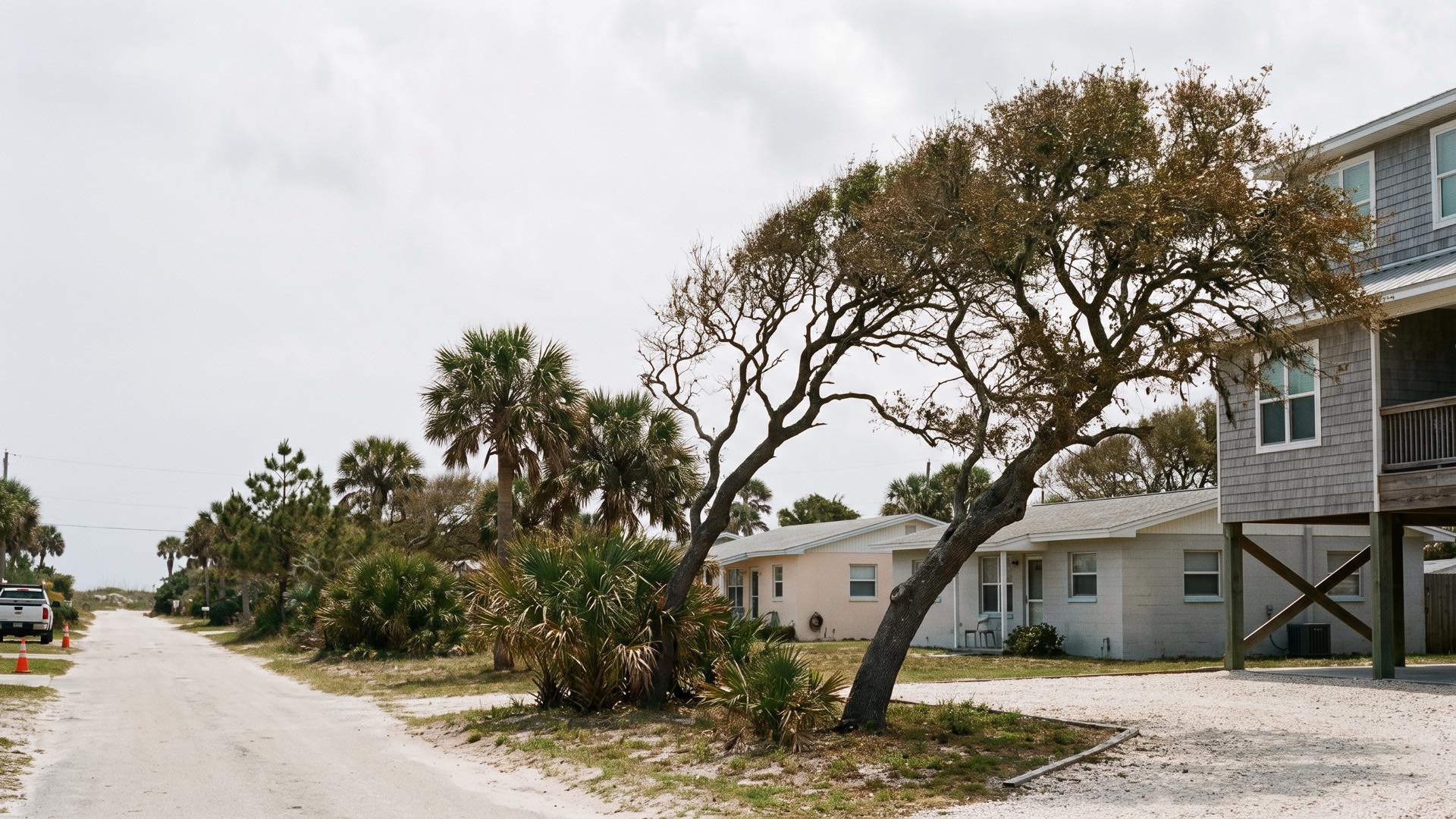
The workhorse here is the coastal live oak — shorter and broader than its mainland cousins, wind-pruned into a seaward lean by decades of salt spray. Around them grow cabbage palms (Florida's state tree, and the most storm-tolerant thing on the island), sand pines and saw palmetto in the scrub that still runs up toward Anastasia State Park, plus southern red cedar, wax myrtle, and ornamental palms around newer construction.
Anastasia Island's soil is the real variable. Sand over coquina — the shell-and-limestone rock this island was quarried for — gives roots a shallow, uncertain grip. That matters twice: a mature oak or pine here holds on with less anchorage than the same tree three miles inland, and stump grinding hits rock at depths that would be clean digging on the mainland. Salt burn is the other local tell. It scorches foliage on the ocean-facing side, so a lopsided canopy is normal at the beach — but browning on all sides, dieback from the top down, shedding bark, or a root plate visibly lifting means the tree may be failing and deserves a look before hurricane season, not after.
Tree services we cover in St. Augustine Beach
Whatever the island's canopy needs, there's a crew for it:
- Tree removal — coastal oaks and pines leaning over close-set island homes.
- Tree trimming — wind-thinning, deadwooding, and roofline clearance before storm season.
- Palm tree service — trimming and skinning for cabbage palms and ornamentals.
- Stump grinding — ground below grade, with coquina depth accounted for.
- Emergency tree service — 24/7 dispatch for trees on structures and blocked drives.
- Storm damage cleanup — full-property haul-off with insurance documentation.
- Certified arborist — hazard assessments and the written report a removal permit exemption relies on.
These ranges hold across the 904 — for the full breakdown of what moves the number, see our Jacksonville tree service cost guide.
Tree removal in St. Augustine Beach
Most island removals come down to access rather than size. A 60-foot oak on a mainland half-acre is a straightforward drop; the same tree on a 50-foot beach lot with a pool cage on one side and a neighbor's roof on the other is a rigging job — pieced down in sections, roped off, and lowered. Soft sand adds another wrinkle: bucket trucks and grapples need matting to avoid sinking or tearing up a yard, and some lots off A1A simply can't take a crane, so the crew works from a bucket or climbs it.
That's why island quotes spread so widely. Small palms and scrub pines sit near the bottom of the range; a large, compromised live oak overhanging a structure with no clear drop zone sits at the top. Every estimate is on-site and free — nobody can price an island removal accurately from a photo.
Tree trimming on the island
Trimming is the cheapest storm insurance available in St. Augustine Beach. The goal is wind-thinning — opening the canopy so gusts pass through instead of pushing against a solid sail — plus deadwooding, clearing limbs off the roofline, and stripping dead fronds off cabbage palms before they become projectiles. On coastal oaks the work is conservative: these trees are already wind-shaped, and over-thinning a salt-stressed oak does more harm than leaving it alone. A good island crew takes less than a mainland crew would, and knows why.
Coastal oak leaning harder every year?
Some lean is just the island look — but a tree losing its grip in the sand is a different story. Get a licensed, insured crew out for a free look before the wind decides for you.
Call (904) 371-6603Storm season on Anastasia Island
A barrier island takes hurricane season on the chin. From June through November, St. Augustine Beach gets wind straight off the open Atlantic with nothing to slow it, plus gusts funneling across the Matanzas from the west — and surge can saturate the sand until root plates simply let go. The cabbage palms mostly shrug it off; it's the sand pines and the older oaks over roofs that turn into emergency calls. The storms that have raked this stretch of the First Coast in recent seasons put crews on the island for days, clearing trunks off cottages and reopening drives along A1A.
The cheaper move is pre-season trimming — thinning sails out of the oaks and stripping dead fronds before the first named storm. When something does come down anyway, 24/7 dispatch gets a crew over the bridge fast, and every storm job comes with the documentation a claim needs. For a full pre-season walkthrough, see the hurricane tree prep guide.
Permits & insurance
On residential property you generally don't need a permit to remove a hazardous tree when a certified arborist documents that it's a danger, under Florida HB 1159 — and trimming never needs one. The local wrinkle matters here: St. Augustine Beach is an incorporated city with its own municipal code, so it is not governed by unincorporated St. Johns County rules the way nearby Vilano Beach is, and it is separate from the mainland city of St. Augustine and its historic-district review. On top of that, dune vegetation around the beach access walkovers carries its own protection — anything growing on or seaward of the dune line gets confirmed before cutting. The crew handles that check for your specific address.
On insurance, homeowners coverage typically pays for removal when a storm-felled tree damages an insured structure — roof, garage, fence, or car — usually up to a policy limit, while a healthy tree down in the open yard generally isn't covered. Every storm job comes with dated photos and a written estimate to support a claim. For the full rundown, see do I need a permit to remove a tree in Jacksonville? and does homeowners insurance cover tree removal in Florida?