Tree service in Crescent Beach and Butler Beach covers the south end of Anastasia Island — coastal live oaks, southern red cedars on the dunes, cabbage palms, and sand pines — with removal, trimming, deadwooding, stumps, and 24/7 storm work by licensed, insured local crews. Removals run roughly $500–$6,000+, trimming and deadwooding start near $500, and palms run about $75–$400+ each, with free estimates. Both communities are unincorporated St. Johns County, and dune vegetation seaward of the state's Coastal Construction Control Line needs a state permit before it's cut.
South of the St. Augustine Beach city limits, A1A runs down a narrowing barrier island through Butler Beach and then Crescent Beach, toward Matanzas Inlet and Fort Matanzas National Monument. Neither is a city: both are unincorporated communities in St. Johns County, and mailing addresses here say "St. Augustine" even though the city of St. Augustine is miles north. Butler Beach carries real history — beginning in 1927, Lincolnville businessman Frank B. Butler bought land between the ocean and the Matanzas River and opened it to Black residents and visitors, at the time the only beach open to them between Jacksonville and Daytona. Today Frank B. Butler County Park keeps both a beachside and a riverside piece of it. Crescent Beach, named for its curving shoreline, is where SR 206 crosses the Matanzas from the mainland to meet A1A. 904 Tree Service connects homeowners on both stretches with crews who work the island.
South Anastasia Island's trees
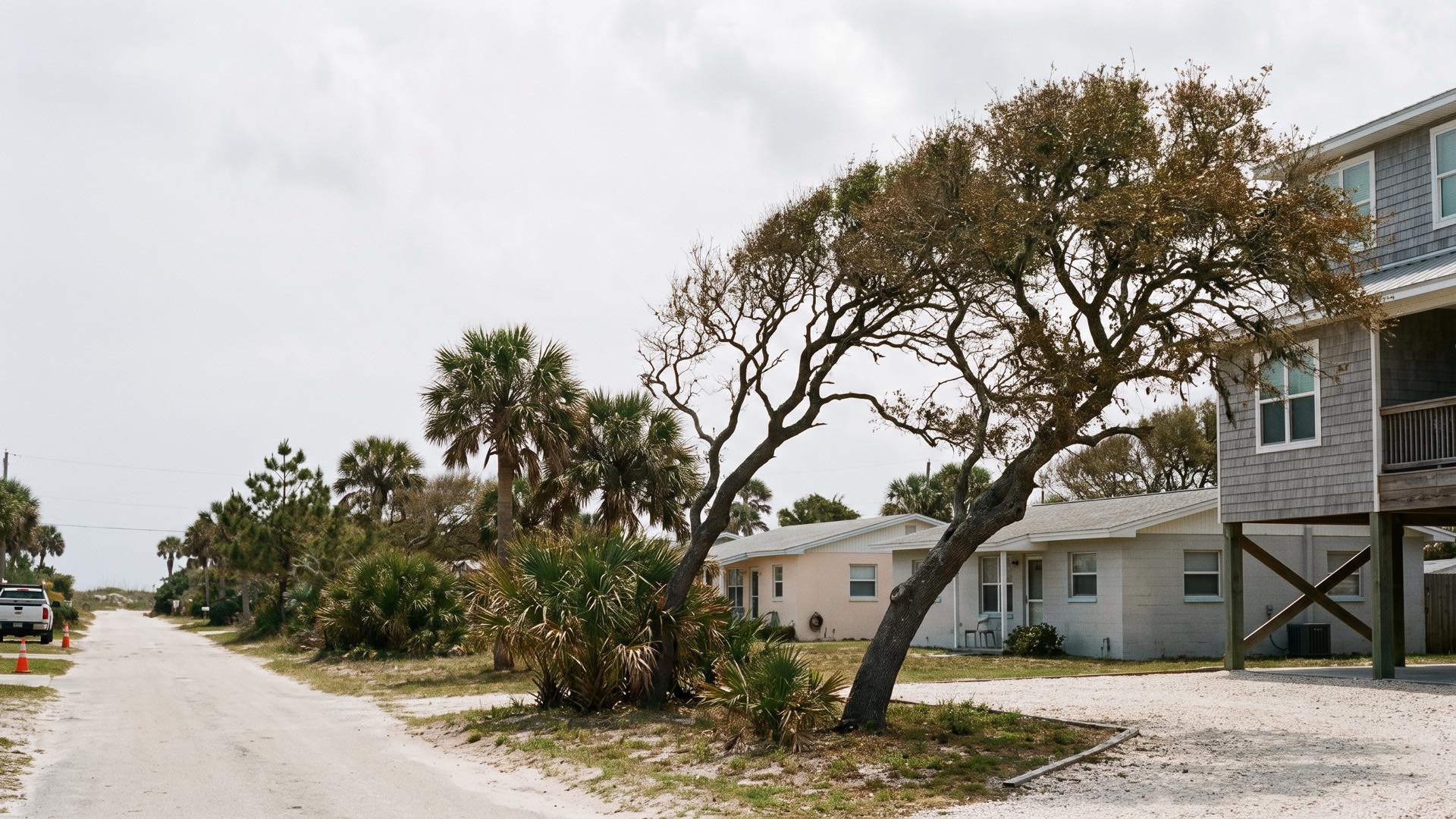
The island is thin here, so almost every lot is either ocean-side, river-side, or close to both. On the ocean side, the dunes and the lots behind them grow southern red cedar, wind-sheared coastal live oaks, cabbage palms, wax myrtle, yaupon, and saw palmetto — all shaped into a low, landward lean by salt spray. On the Matanzas side, the oaks grow taller and fuller in the shelter of the hammock, with pines and palms mixed through. The soil is sand, and roots hold on with less anchorage than the same tree would have on the mainland. Salt burn on the seaward face is normal; browning on every side, top-down dieback, or a root plate lifting in the sand is not.
Deadwooding & tree trimming in Crescent Beach and Butler Beach
Deadwooding is pruning out the dead, dying, and broken limbs inside a canopy — and on this stretch of coast it's the most useful trim there is. Salt and wind kill twigs and small limbs on the ocean-facing side of oaks and cedars every season, and a canopy full of dead wood is a canopy full of storm debris waiting to hit a roof, a window, or a car. A good deadwooding pass cuts back to live tissue at proper branch unions and leaves the healthy, wind-shaped structure alone.
That restraint matters. Coastal oaks and cedars are already sculpted by the wind, and heavy thinning or "lion-tailing" a salt-stressed tree opens it to sunscald and more dieback. The right island trim is usually deadwooding plus light clearance — lifting limbs off the roofline, away from service drops, and clear of the driveway — along with stripping dead fronds off the cabbage palms before they become projectiles. Deadwooding is typically priced as part of a tree trimming visit, from around $500, and the best time is before June, ahead of hurricane season.
Tree services we cover
- Tree removal — dead pines, failing oaks, and trees leaning over island homes.
- Tree trimming — deadwooding, roofline clearance, and light wind-thinning.
- Palm tree service — trimming and skinning for cabbage palms and ornamentals.
- Stump grinding — ground below grade in sandy island soil.
- Emergency tree service — 24/7 dispatch for trees on structures and blocked drives.
- Certified arborist — hazard assessments and the written report a permit exemption relies on.
These ranges hold across the 904 — for the full breakdown of what moves the number, see our tree service cost guide.
Tree removal in Crescent Beach and Butler Beach
Island removals are access jobs. Many homes here are elevated on pilings, lots are narrow, and the only approach may be a short sand drive off A1A — so a large oak beside the house usually comes down in rigged sections rather than one drop. Soft sand means trucks and grapples need matting, and some lots can't take a crane at all. A dead pine or small palm with open space sits near the bottom of the range; a big compromised oak over a raised home with no drop zone sits at the top. Every estimate is on site and free.
Dead limbs piling up on the seaward side?
Get a licensed, insured crew out for a free look before hurricane season — a deadwooding trim now beats a limb through the window later.
Call (904) 371-6603Storm season south of St. Augustine Beach
From June through November, this end of the island has little between it and the open Atlantic. Hurricane Matthew in 2016 and Irma in 2017 eroded the dunes along the St. Johns County coast, washed over sections of A1A, and led the county to rebuild miles of dunes afterward. For trees, the pattern is saturated sand, wind from the ocean and gusts across the Matanzas, and root plates that let go. When something comes down, 24/7 emergency tree service gets a crew down A1A to make the house safe, with the documentation a claim needs. For pre-season steps, see the hurricane tree prep guide.
Permits & insurance
Under Florida HB 1159 — now Section 163.045, Florida Statutes — a residential tree can come down with no local permit when a certified arborist documents in writing that it poses an unacceptable risk, and trimming never needs a permit. Because Crescent Beach and Butler Beach are unincorporated, St. Johns County's rules apply — not the city code of neighboring St. Augustine Beach. The coastal wrinkle: cutting or damaging dune vegetation seaward of the Coastal Construction Control Line generally requires a permit from the Florida Department of Environmental Protection, and no arborist letter overrides that. On oceanfront lots, the crew confirms where the line falls before any cutting. More in our tree permit guide.
On insurance, homeowners coverage typically pays for removal when a storm-felled tree damages an insured structure, usually up to a policy limit, while a tree down in the open yard generally isn't covered. Every storm job comes with dated photos and a written estimate. See does homeowners insurance cover tree removal in Florida?