Tree removal in St. Augustine runs $500–$6,000+ — a small tree is often $300–$700, and a large live oak needing a crane starts around $3,000. The on-site estimate is free. Inside city limits, removing any tree 3 inches or larger normally needs a city permit — unless a certified arborist documents it as a hazard under Florida law.
"St. Augustine" on a mailing address can mean three different rulebooks. There's the City of St. Augustine — the historic downtown, Lincolnville, the mainland neighborhoods, and Davis Shores across the Bridge of Lions on Anastasia Island. There's the separate City of St. Augustine Beach further down the island. And there's unincorporated St. Johns County, which takes in Vilano Beach and much of the surrounding area. 904 Tree Service routes your job to a licensed, insured local crew that sorts that out before anyone starts a saw.
What tree removal costs in St. Augustine
The prices here match the rest of the 904 — the lot drives the number, not the zip code. What St. Augustine adds is a lot of expensive lots: century-old oaks planted within feet of historic walls, narrow old-town streets where a chip truck barely fits, overhead lines threaded through the canopy, and island yards where soft sand means matting before a bucket truck can roll in.
Size, access, proximity to the house or lines, crane needs, and cleanup volume all move the final figure. For the complete breakdown by service and tree size, see the tree service cost guide.
Permits: which rulebook covers your tree?
This is where St. Augustine really differs from Jacksonville. Before any removal, confirm which of these applies to your address:
- City of St. Augustine. The city requires a permit to cut down, remove, or "effectively destroy" any tree 3 inches or larger in diameter at breast height (measured 4.5 feet up), and southern red cedars are protected at an even smaller size. When a removal is approved, each tree is replaced with two similar trees on the site, or the owner can pay $300 per replacement tree into the city's Tree Mitigation Fund.
- The hazard exception. Florida's HB 1159 (Section 163.045, F.S.) still protects a documented hazard removal at a single-family home: when an ISA-certified arborist or licensed landscape architect assesses the tree on-site and finds it poses an unacceptable risk, no local permit, fee, or replacement is required. The crew arranges that assessment.
- Unincorporated St. Johns County. Looser for existing homes: on a single-family home site of one acre or less, most trees can come down without a county permit. The exceptions are designated Historic and Specimen Trees — typically very large native oaks and other hardwoods — which need county approval unless diseased or a substantial threat to the house, and dune vegetation seaward of the Coastal Construction Control Line, which the exemption doesn't cover.
- St. Augustine Beach. Its own city and its own code — see tree service in St. Augustine Beach.
For the full statewide picture, read do I need a permit to remove a tree. This is general information, not legal advice — verify for your address before cutting.
The trees that come down most here
Southern live oaks are the headline — and the hardest calls, because most of them are worth saving and many are protected. They usually come out only when they're dead, split, rotting at the base, or leaning toward a structure after a storm. Laurel and water oaks, shorter-lived and weaker-wooded than live oaks, are frequent removals as they decline. Slash and sand pines snap or uproot in wind, especially when the sandy soil is saturated. And sabal palms — hardy as they are — come down when disease or a lightning strike finishes them. On Anastasia Island, salt spray burns the ocean-facing side of every canopy; a one-sided oak is normal there, but dieback from the top down is not. See signs a tree is dying or dangerous.
Crane and rigging work in the historic city
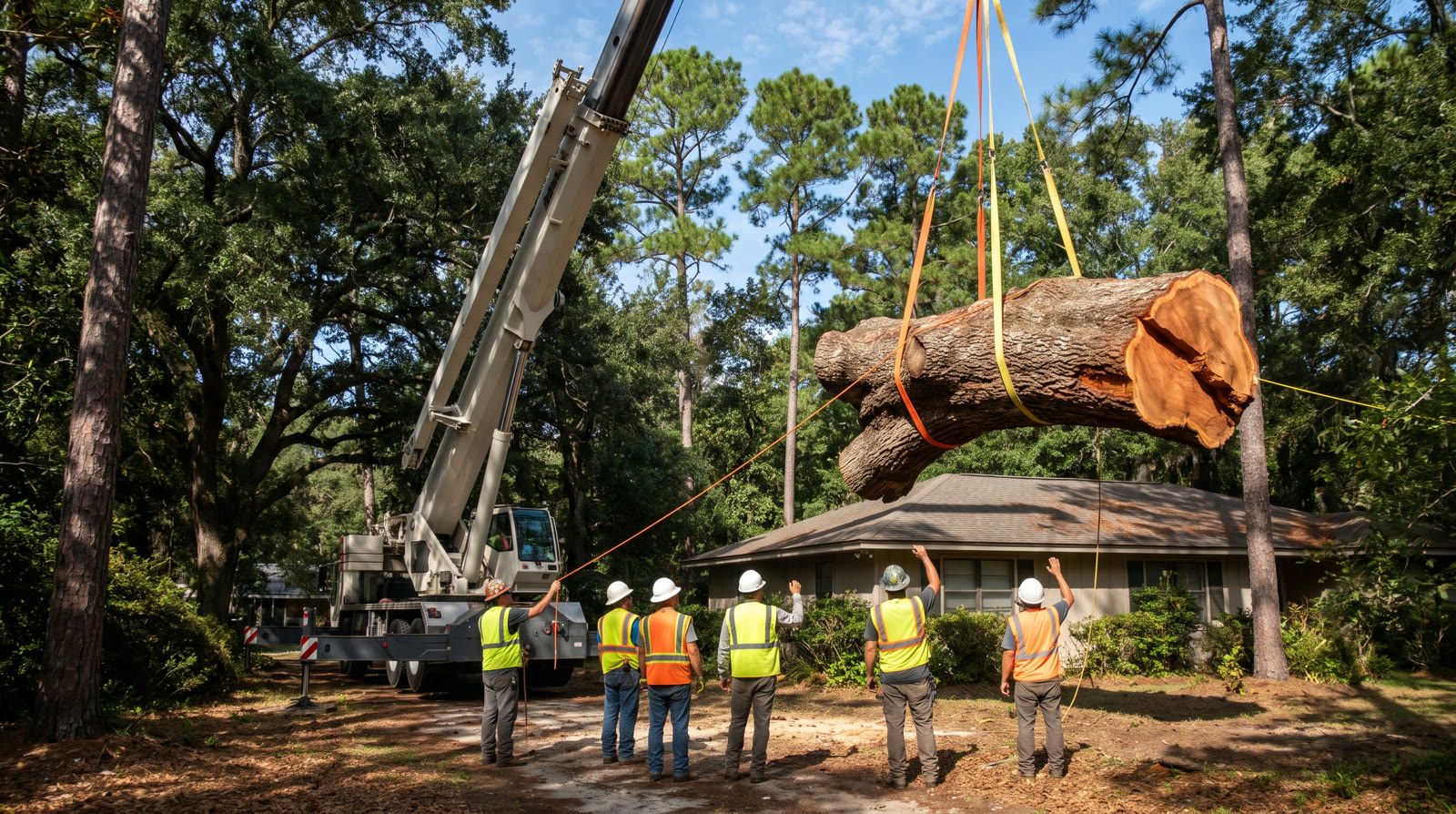
Many of St. Augustine's big oaks grew for a century before the houses and fences filled in around them, so there's often nowhere to drop anything. The crew rigs the tree down in controlled sections — or sets a crane in the street or driveway and lifts each piece up and over the roof instead of swinging it past two-hundred-year-old masonry. That planning is why crane removals sit at the top of the price range — and on the trees that need one, it's the safe method.
Oak leaning toward the house?
Get a licensed, insured St. Augustine crew out for a free look before hurricane season decides for you — and find out whether it's a removal, a hazard letter, or just a good prune.
Call (904) 371-6603Storm exposure and timing
St. Augustine faces the Atlantic, the Matanzas, and the San Sebastian, and it floods. Hurricane Matthew in 2016 and Hurricane Irma in 2017 both pushed water into the historic districts and waterfront neighborhoods like Davis Shores and Lincolnville — and flooded, saturated sand is exactly when shallow-rooted oaks and pines let go. Nor'easters add another round of wind every fall and winter. The cheapest removal is the hazard tree you take down in spring, before the storm queue forms; once a tree is on the roof, it's a job for 24/7 emergency tree service.
Cleanup, the stump, and alternatives
Every removal includes hauling the limbs, logs, and debris. The low stump left behind can be ground below grade the same day or on a later visit — see stump grinding in St. Augustine. And if the tree is healthy but crowding the roof, a proper prune is often the better answer: see tree trimming and pruning in St. Augustine. For how removals work anywhere in the 904, see our main tree removal service page, or go back to the St. Augustine tree service overview.